
IRS Resumes 226-J Enforcement: What 0Employers Need to Know for 2024
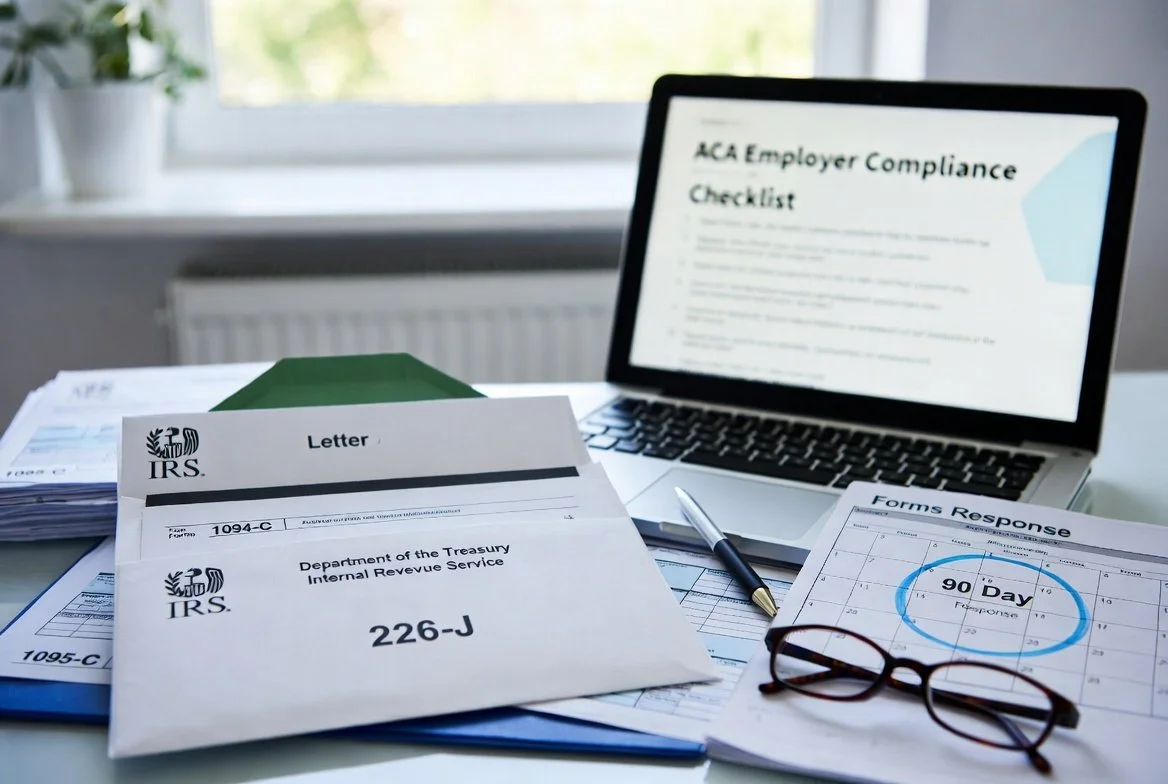
If your organization offers group health coverage and you've received an IRS Letter 226-J, you're not alone — and it doesn't automatically mean you owe a penalty.
Letter 226-J proposes what the IRS calls an Employer Shared Responsibility Payment, or ESRP — better known as the ACA "pay or play" penalty. It's based on the IRS's review of your Forms 1094-C and 1095-C. Sometimes the proposed penalty is accurate. Just as often, it stems from a filing error — and a timely, well-documented response can reduce or eliminate it entirely.
This past July, the IRS began issuing 226-J letters for the 2024 calendar year to employers whose ACA filings suggest potential non-compliance.
What's Actually in the Letter
Each Letter 226-J includes an ESRP Summary Table showing how the IRS arrived at its number. It will point to one of two issues:
Penalty A — coverage wasn't offered to at least 95% of ACA full-time employees.
Penalty B — coverage was offered, but it wasn't affordable or didn't meet minimum value.
You'll also receive an Employer Premium Tax Credit (PTC) Listing. This shows which full-time employees received a premium tax credit through the ACA marketplace, matched against what your Form 1095-C said about their coverage offer.
What to Do First
Don't take the IRS's number at face value. Compare it against your original ACA filings, payroll records, and enrollment data. Mismatches between what was filed and what actually happened at the plan level are common — and they're often exactly why a penalty can be reduced or removed.
Watch the Clock
Every 226-J letter comes with a response deadline of at least 90 days from the letter date. You'll typically respond using Form 14764, along with documentation and, if needed, a written explanation. Missing that deadline means losing your right to appeal. There's no second chance once the window closes.
A Second Penalty Can Follow
Correcting your 1094-C or 1095-C filings in response to an IRS inquiry can trigger its own penalties, based on how many forms are corrected. For the 2024 filing year:
$330 per form for an inaccurate Form 1095-C furnished to an employee.
$330 per form for an inaccurate Form 1094-C/1095-C filed with the IRS.
A reasonable cause exception may offer relief here if you can show a legitimate basis for the original error.
What Employers Should Be Doing Now
Watch your mail for Letter 226-J and other ESRP-related IRS correspondence.
Keep Forms 1094-C and 1095-C, plus supporting records, for several years past filing.
Maintain complete records of coverage offers and enrollment elections — including waivers and declinations.
Keep current and past plan documents and Summary Plan Descriptions easy to find.
Preserve the affordability calculations behind your ACA compliance position.
Document how you classified employees (full-time, part-time, variable-hour) and why.
Be ready to back up any dispute with documentation — the burden of proof is on the employer.
Remember: the IRS has up to six years from the ACA reporting deadline to assess a penalty.
Loop in your benefits advisor early if you need to correct a 1094-C or 1095-C — getting the correction right matters as much as making it.
This article is provided for general informational purposes and does not constitute legal, tax, or accounting advice. Employers should consult qualified legal or tax counsel regarding their specific circumstances.
---
Marsha Marrullier, REBC
Strategic Employee Benefits Advisor, ARCW Leavitt Insurance Group
Marsha-Marrullier@Leavitt.com | (754) 315-5211 | marshamarrullier.com